How the stalk becomes bedding, fiber, and soil. Dakota Hemp in Wakonda is the working mill. This tab is not their blog, and it is not a shop.
0. How to read this classroom
Industrial hemp is Cannabis sativa L. grown for stalk, grain, or seed. Under Public Law 119-37 the plant is hemp when total THC is at or below 0.3 percent dry weight. That statute was signed 12 November 2025. It takes effect 12 November 2026. This classroom stays in that lane.
Floral products and intoxicating hemp-derived cannabinoids are out.
The same species can be grown four ways. Fiber plants are sown thick for stalk. Grain plants are sown thinner for seed. Dual-purpose stands try to do both and usually do neither at the top of the range.
Floral stands are a different crop, a different license conversation, and not a product of this site.
Read every dollar with its unit. A farm-gate price for retted stalk is not a bag of bedding. A barn’s savings against pine is not the mill’s sales. A compost sale is not a second copy of the barn’s compost credit. Module 10 is the key for the rest of the site.
If a sentence here and a sentence on the stall ledger disagree, the ledger wins.
Dakota Hemp, at 45304 302nd Street in Wakonda, South Dakota, is the working United States reference mill. It already sells cleaned hurd as stall bedding. It is not the author of this tab. Canadian Greenfield builds the HempTrain that Dakota runs.
Formation Ag builds the FiberTrack 660 that Complete Hemp Processing runs in Winfred, South Dakota. Those are two machines. This classroom does not pick one.
Sources sit at the bottom of each module. NASS figures come from the National Hemp Report, hempan26.pdf, April 2026. Stall figures come from the ledger on this site. Law comes from the statute, not from a trade-association summary.
If a number is an estimate, the sentence says so. If a number is published, the sentence names who published it.
Nothing here is a store. There is no buy button. A barn that wants a price uses the stall ledger. A mill that wants a machine uses the plant page. A reader who wants the product list uses the catalog. This page is the reason those tools exist.
If you only read one module, read the plant, then the bedding, then the numbers. The rest is how the stalk gets from a field to those three pages without becoming a waste bill.
A hemp stalk is a tube with a job. The outside skin is the epidermis. Under it is the bast, the long fiber that runs the length of the stem. Inside that is the hurd, also called shiv, the woody core. In a fiber stand the hurd is about 70 percent of the stalk mass.
The seed, when the plant is allowed to set it, is the grain. Those are three crops. The flower is a fourth, and it is not this classroom.
Hurd is light because it is porous. The cells are mostly cellulose and lignin, with air between them. That air is why a bag of hurd drinks liquid. Dakota’s bedding spec and the bedding literature describe absorbency up to four or five times the hurd’s weight.
This site books two to four times as the conservative stall number. The higher figure stays in the spec. It is not the ledger.
Bast and hurd are separated by decortication, which module 5 covers. Before that split they are one stalk. After it they do not share a price. Bast is priced as fiber. Hurd for stalls is priced as a bag. Grain is priced as seed. Floral is priced as a flower crop.
Mixing those prices is the most common mistake on a hemp slide.
A fiber-only variety is bred for height and a thin stem so the bast stays long and the hurd stays a clean woody chip. A grain-only variety is shorter and branches more, because the farmer wants seed, not a textile fiber. Dual-purpose varieties are a compromise.
They can feed a mill that wants both, and they rarely match a specialist on either yield. NASS reports fiber and grain as separate lines for that reason.
Cellulose is the part that holds water and, later, the part that breaks down in a compost pile. Lignin is the part that makes wood last. Pine shavings are lignin-heavy, which is why a pine pile sits for years.
Hurd has enough lignin to be a stable chip in a stall, and not so much that a managed pile cannot finish in a season. That is the physical reason the stall and the pad are one loop.
The plant does not care what the barn calls the product. It grows a stalk. The mill decides which fraction gets a buyer. If bast, hurd, fines, and the spent bedding all have a home, the stalk does not become a dump fee.
Source. Dakota bedding spec (absorbency). NASS hempan26.pdf, Apr 2026, fiber and grain lines. This site books 2–4× liquid hold.
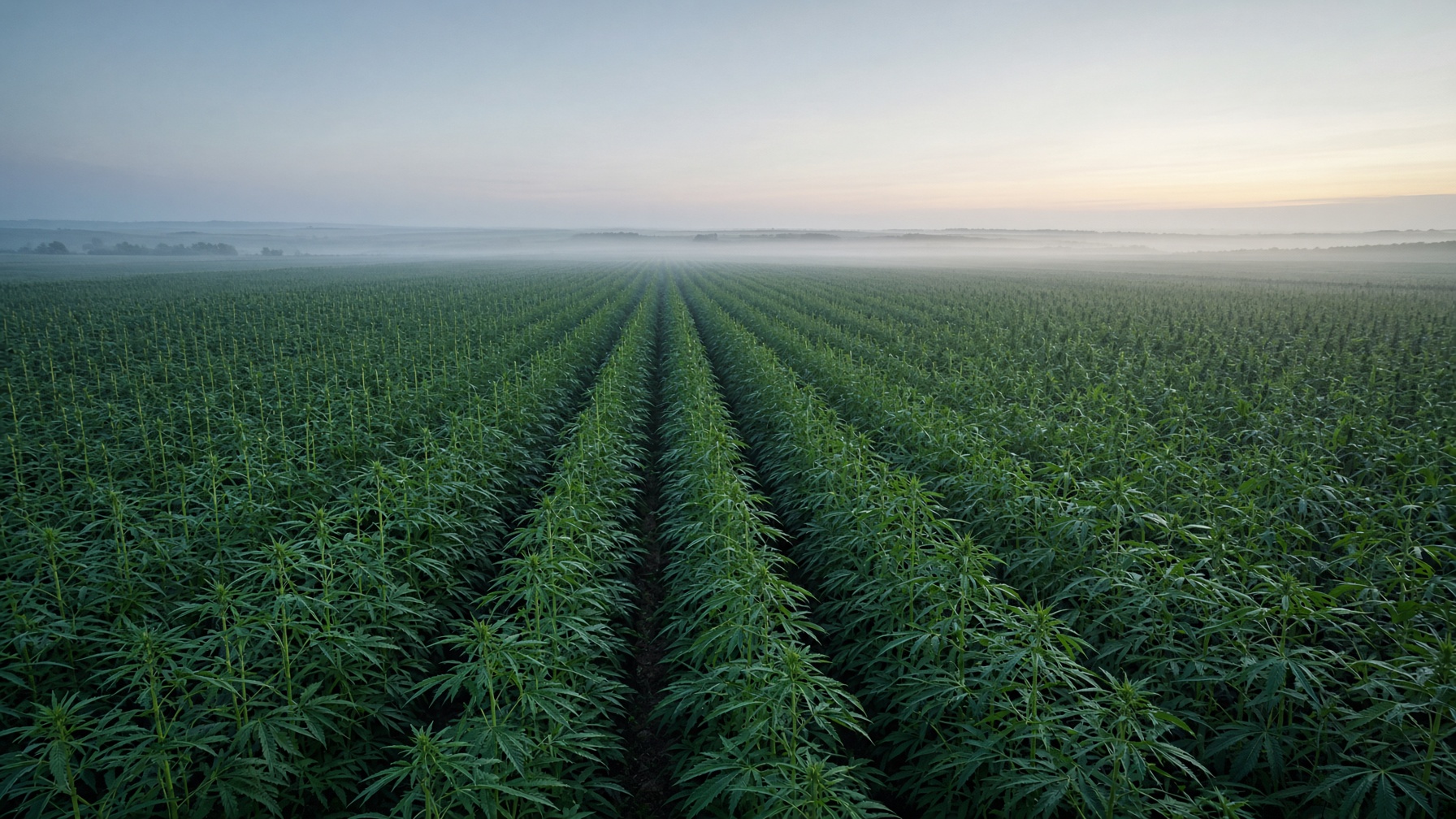
Fiber hemp is a field crop, not a garden. Dakota’s education notes put fiber and hurd seed at about 22 pounds an acre. The stand is dense on purpose. Plants shade each other, stretch for light, and stay thin. A thin stalk is what a decorticator wants.
A bushy plant is a grain plant or a floral plant that wandered into the wrong field.
Days to a fiber harvest run about 90 to 120, depending on the cultivar and the latitude. The farmer is cutting for stalk, not for a ripe flower. Harvest timing is a trade. Cut too early and the hurd is light and the yield is short.
Leave it too long and the core fills, the fiber coarsens, and the retting window gets harder to hit before frost.
Height is not the same thing as a good hurd. A tall hollow stem gives a light, even chip. A stem that has filled in is heavier and can carry more lignin in the core. The mill wants a consistent chip size after the break. That starts in the seeding rate, not at the bagger.
The planting window is the local small-grain window. Hemp wants a warm soil and a stand that can outrun weeds.
Extension guides, including Rutgers NJAES on fiber production, treat it like a dense annual: close rows, a real seeding rate, and fertility from a soil test rather than a slogan. Water use is closer to a grain crop than to an irrigated specialty.
The pesticide profile is thin compared with cotton, which is sprayed often for insect and defoliation. That comparison is from extension practice, not from a marketing line. Hemp is not immune to disease. It is simply not cotton.
Fiber hemp is cut for the stalk. The flower is not the product. A field that is managed for cannabinoids is a different density, a different harvest, and a different buyer. A floral field is not a bedding supply.
The acre this site cares about is the acre that can reach a mill inside about 100 miles. A beautiful stand 400 miles from a decorticator is a freight problem, not a supply.
A fiber field is harvested once for the stalk. There is no second cut of flowers hiding in the budget. The seed rate, the row, and the calendar are the whole agronomy this mill needs.
Source. Dakota education notes, about 22 lb seed/acre for fiber and hurd. Rutgers NJAES FS1343, hemp for fiber. This site’s 100-mile inbound rule.
Retting is how the stalk lets go of its fiber. Pectins glue the bast to the hurd. Dew, rain, and microbes on the ground eat those pectins. The farmer cuts the crop, leaves it in a windrow, and turns it. Typical field retting is two to five weeks.
It is weather, not a machine setting.
When the retting is right, the fiber peels in long pieces and the hurd breaks clean. When it is short, the bast still clings and the mill works harder and makes more fines. When it goes too long, the fiber itself weakens.
Over-retting is a yield loss on the bast, not a better hurd. The windrow is a clock.
Green decortication skips that wait. The mill takes stalks that have not been retted and separates them mechanically. The fiber is different. It is often called green decorticated fiber. Hemp Traders prices a green decorticated grade. A retted textile fiber is another grade.
Averaging the two grades invents a price nobody pays.
Moisture before the bale matters more than the story. About 15 percent is the practical target before baling. Wetter than that and the bale heats. Drier than that and the stalk shatters in the baler and again in the mill. A hot bale is a fire risk and a fiber-quality risk.
The mill cannot un-cook it.
France and the Netherlands have run dew-retted bast crops for a long time, mostly flax, with hemp beside it. Their practice is the reference for turning a windrow, not a bid for this mill. Dakota’s field notes are the United States reference for the crop this site is siting.
Use both as practice. Neither one is a capex line.
Retting is the step most business plans skip because it is not a piece of steel. It is the step that decides whether the steel has anything clean to separate.
Turn the windrow. Watch the color. Pull a stalk and see if the bast slides. If it does not, wait. If the fiber is already falling apart, bale. That test is older than any decorticator on this site, and the mill still depends on it.
A mill that buys only green, unretted stalk should say so in the grower contract. A mill that wants retted stalk should say how long the windrow is allowed to sit. Silence on retting becomes a fight at the scale.
Source. Dakota field notes. European dew-retting practice, France and the Netherlands, as practice only. Hemp Traders green-decorticated grade.
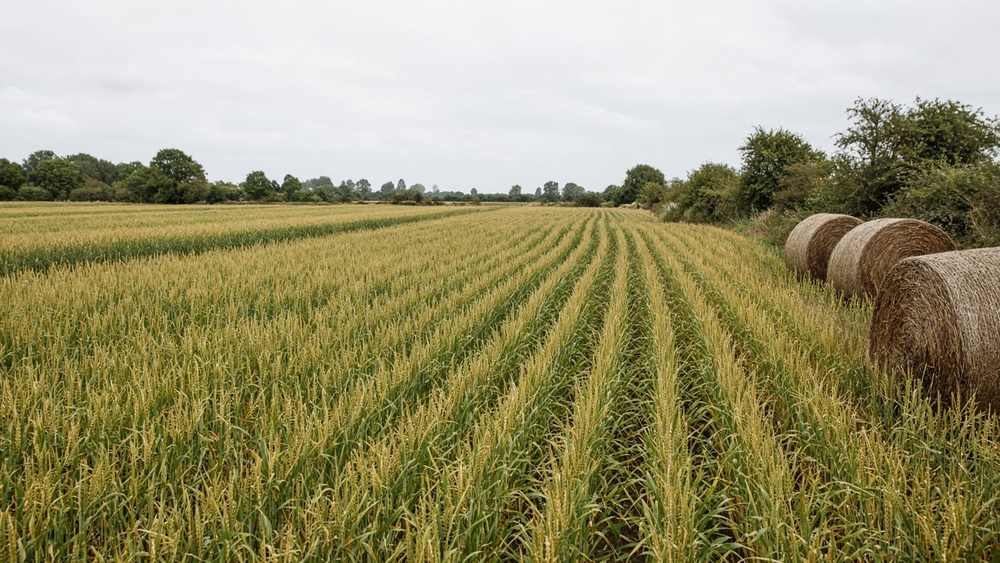
The harvest line is ordinary hay equipment pushed hard. A sickle or a swather lays the stalk down. The windrow sits for retting. A rake turns it. A round baler or a square baler picks it up. Hemp is hard on belts, bearings, and knives.
The stalk is tougher than grass and more abrasive than most hay. Budget the wear. A hay custom rate is not this harvest.
Bale form is a freight choice. Round bales are common and awkward on a truck. Square bales cube better and need a baler that can take the stalk. Dakota takes round or square from inside about 100 miles. That radius is the siting rule on this site.
A mill that plans to pull bales from three states is planning a freight bill, not a supply shed.
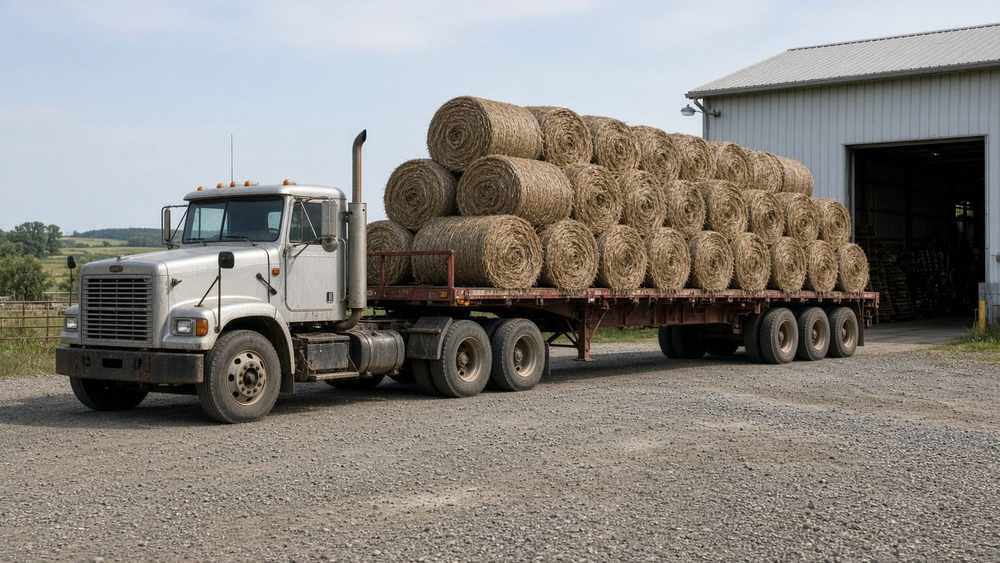
One Dakota-class mill on this site is planned at about 1,600 tons of stalk a year. A load is planned at about 18 tons, because hemp bales fill the trailer before they hit the weight limit. That is about 89 inbound loads a year.
Those loads are the first job of the same truck that later hauls bedding out and waste back.
The field has to be ready when the mill is ready. A late retting window that collides with a wet October produces bales the mill cannot run. Storage on the farm or on the mill yard has to keep those bales dry. A wet bale is not inventory.
It is a compost pile that started too soon, in the wrong place.
Harvest is also the moment the lot identity starts. A USDA lot tag and a pre-harvest test belong to the legal module. On the practical side, the mill wants to know which farm, which cutting, and which moisture.
A bale with no identity cannot be priced and cannot be traced if a test comes back late.
The harvest picture is a baler in a fiber field, not a combine in a floral field. Fiber hemp is cut for stalk. The baler is the machine that matters.
Count the loads before you count the acres. Eighty-nine inbound trucks is a dispatcher’s year, not a slogan. If the bales cannot sit dry between those trips, the mill’s runtime is a weather story.
Square bales stack. Round bales roll. The mill can take both. The yard has to be drawn for the one the growers actually own.
Source. This site: ~1,600 tons/year, ~18 tons/load, ~89 inbound loads, ~100-mile radius. Dakota bale practice, round or square.
Option B — FiberTrack 660. Winfred, SD. 1 tph. Core $226,470. Bedding-ready about $862k, an estimate.
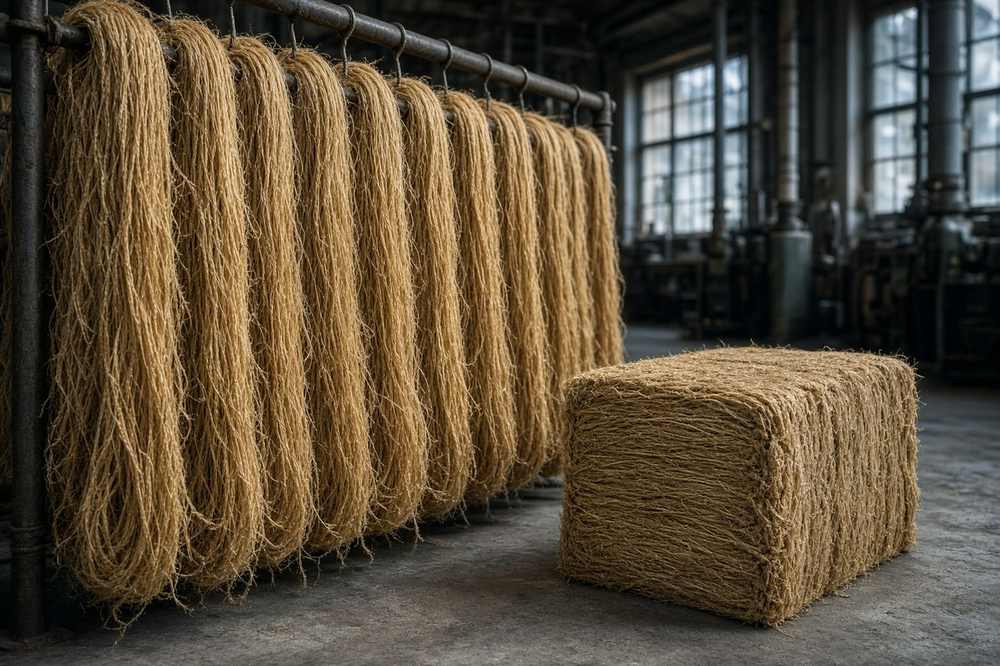
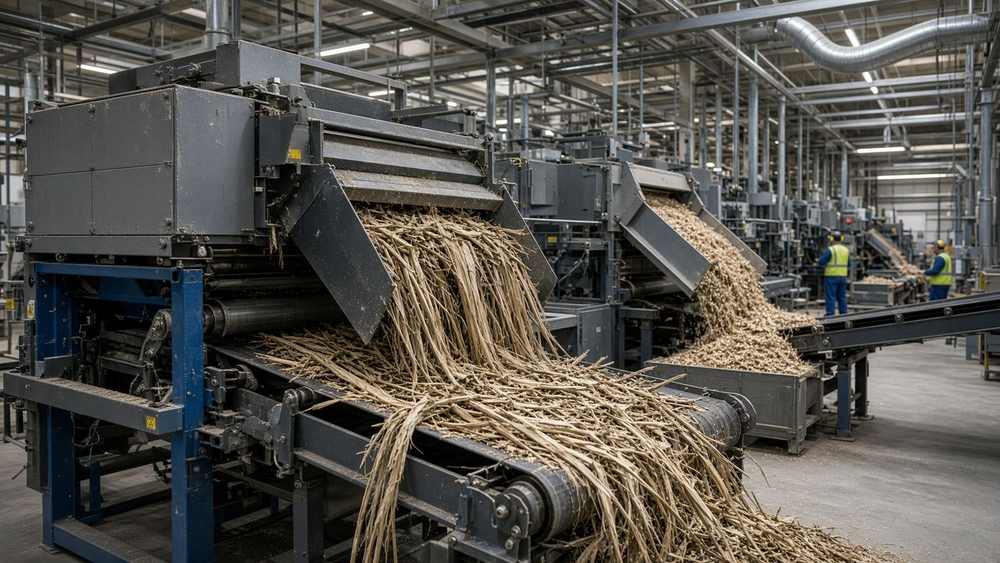
Decortication means one thing: break the stalk so the bast comes off the hurd. Everything else is cleaning, cutting, and bagging. The word is not a brand.
Option A is the Canadian Greenfield HempTrain. The proof plant is Dakota Hemp in Wakonda, South Dakota. The nameplate is 3,000 pounds an hour. Dakota’s proven rate is 2,000 pounds an hour. The fiber can stay intact out to 36 inches.
A CARD module is described as taking residual hurd in the fiber from about 15 percent down to about 2 to 3 percent. A full installed price is not published here. The train itself has been valued at $3.5 million inside a larger license conversation.
This page does not invent the missing quote.
Option B is the Formation Ag FiberTrack 660, built in Monte Vista, Colorado. The proof plant is Complete Hemp Processing in Winfred, South Dakota. The official rate is 1 ton an hour. The published core is $226,470.
A bedding-ready line, core plus the modules a stall mill actually needs, is estimated here at about $862,000. That estimate is not a bid. The plant page holds the full side-by-side table. This classroom does not repeat a second table and does not pick a winner.
After the break comes the cleanup. Scutching knocks the remaining hurd off the fiber. Hackling combs the bast. Screening sorts the hurd by size and pulls fines. Bagging puts the bedding grade in a 30-pound bag or a tote. Fines are not trash if a buyer exists for them.
They can be a building-grade dust, a pellet, or a compost carbon. There is no mill waste stream if bast, hurd, fines, and the spent bedding all have a buyer. If one of those has no buyer, it is a pile, and a pile is a cost.
The stall is the first buyer this site underwrites. The bast buyer is the second. The compost buyer is the third, and it is the same acres that grew the stalk, or a nursery, not a landfill. Steel follows the letter from the barn. It does not lead it.
A micro-decorticator on a trailer is a farm tool. It is not either of these regional mills. A regional plant is not priced off a machine that fits in a shed.
Phase 1 is five people on the mill floor: a mill lead, a line operator, a bagger, a loader, and a yard hand. The mill opens without owning the trucks. Haul is subcontracted. The loop can be added when the pile is real. It is not required to open the mill.
Source. CGT HempTrain spec. Formation Ag FiberTrack list, core $226,470. Dakota Hemp, Wakonda. Complete Hemp Processing, Winfred. Full table on /plant.
The bag is the product the barn sees. Dakota’s published ladder runs from $20 a 30-pound bag down to $16 at the multi-pallet step. That is about $0.53 to $0.67 a pound of cleaned, bagged hurd. It is not the NASS farm-gate price for retted stalk.
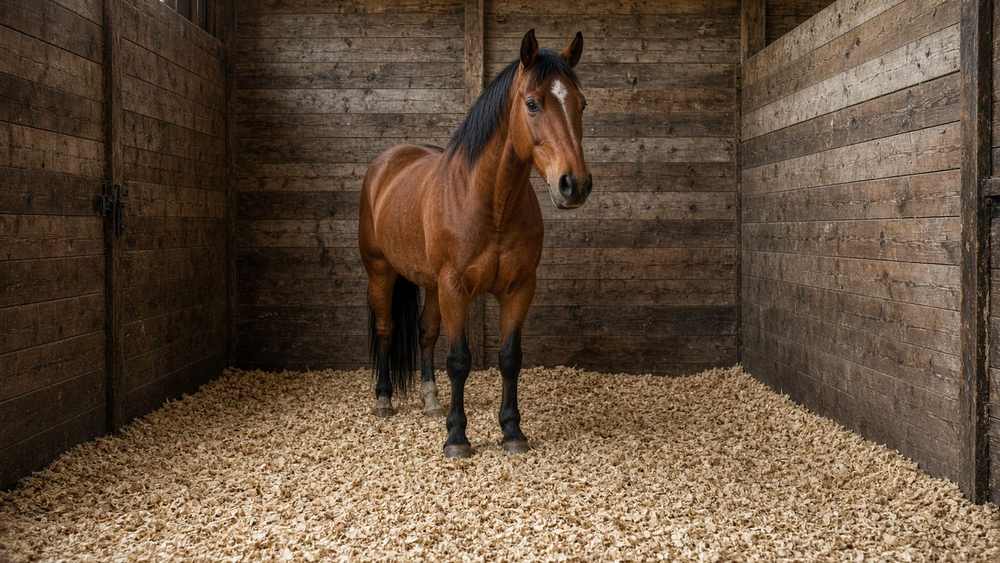
A 12 by 12 stall is 144 square feet. The initial bed used here is about 1.25 pounds per square foot, on the order of 180 pounds, a handful of bags. The conservative top-up is about 2.1 pounds per square foot per year, about 302 pounds, about 11 bags. The hurd stays in the stall.
It is not stripped to the mat every month the way a dusty pine program often is.
The conservative net versus pine is $1,081 per stall per year. That figure already includes the material, the labor, the haul, and half the compost. It is the barn’s number. A serious pine program at a racing barn often runs $1,500 to $3,000 or more per stall per year all-in.
The $1,081 is the difference this ledger will sign, not a brochure range.
Dust and ammonia are the daily reasons a barn switches, before the spreadsheet. In the relative-absorption comparison already on the compost page, hemp binds more ammonia than wood chips, about 60 versus 44, and straw is far lower, about 4.
Less ammonia in the air is a stall that a horse and a groom can live in. It is not a medical claim.
Peter Iovino, racing secretary at Saratoga Casino Hotel, letter dated 19 August 2026, confirmed in writing that the barn uses shavings only, because haulers will not take sawdust. That is the gate this theory walks through. The track already rejected the cheap woody waste.
Hurd is the bedding that does not become that waste.
Saratoga’s published count is 1,820 stalls in 90 barns. Times $1,081 that is $1,967,420 of barn-side net. It is a letter on stalls that exist. It is not a national market drawn on a slide.
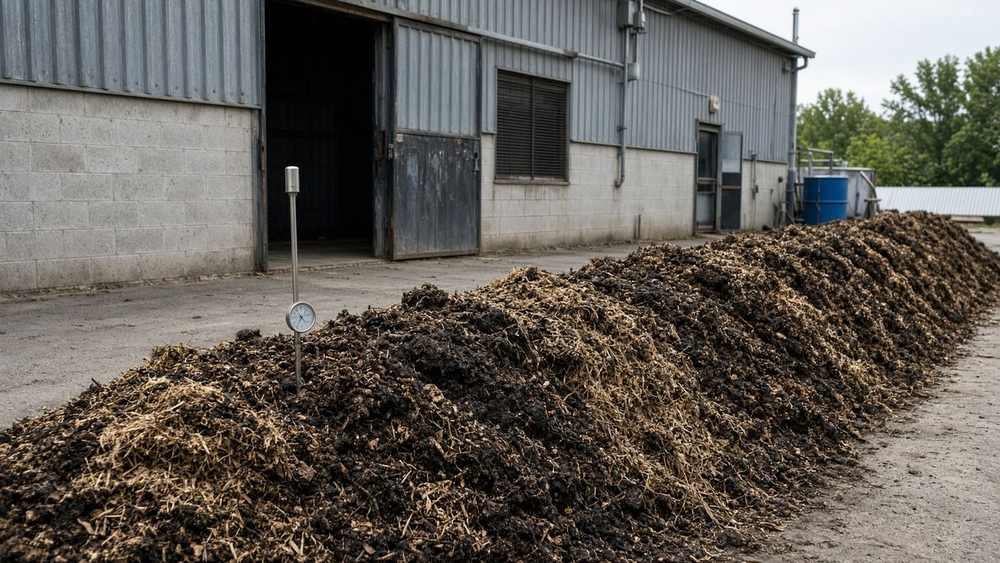
The compost clock starts in the stall, not on the pad. Six to nine months is the managed finish, counted from a pile that is actually built. A stall that is topped up and never stripped still produces that waste. It just produces less of it than pine.
Wet footing is the hoof problem the bag is meant to stop. Urine left on the surface softens the wall and the white line, and it leaves a warm pocket in the frog. Hurd draws that liquid down into the lower layer, so the surface under the hoof stays drier.
The failures named for a chronically soft hoof are thrush, white-line disease, hoof-wall separation, and sole bruising.
A Finnish measurement over fourteen days put ammonia at 145 milligrams per cubic meter above hemp, 155 above wood shavings, and 178 above straw. That is the air reading. The 60 percent relative figure is already above. Ammonia damages the lining of the airway and raises mucus.
The conditions named for that irritation are heaves, also called recurrent airway obstruction, inflammatory airway disease, exercise-induced pulmonary hemorrhage when inflamed capillaries break under work, and a chronic cough.
A 2025 University of Kentucky trial composted each bedding for a week with manure and simulated urine. Hemp hurd finished at 144 colony-forming units of E. coli and fecal coliforms. Pine shavings finished at 248. Chopped straw finished at 257.
A wet, high-count bed is the path into a sole abscess or into cellulitis, and it is how those infections move through a barn.
A Lithuanian stall trial still showed a dry, smooth surface after a full week, with urine filtered underneath. Hurd stays springy. It does not pack into a hard mat. A hard mat concentrates the horse’s weight on the joints.
Joint stress, ringbone, and navicular strain are the names for that load.
Horses that eat bedding can take in enough volume, sometimes with sand, to block the gut. That blockage is sand colic or an impaction. Hurd is low in leftover protein and has little taste, so most horses stop sampling it after a day or two. The stall stays bedding.
What the horse breathes is the screened woody core, not the fines. Respirable dust lodges in the lower airway. Over time that load is named as coughing, chronic obstructive pulmonary disease, and cumulative lung damage.
A Virginia barn trial recorded about 17 percent lower monthly bedding expense after the switch, from less volume and a cleaner stall.
The hurd itself tested at a carbon-to-nitrogen ratio of 87.2 to 1, against 81.2 for pine and 58.7 for straw. That is a bedding assay. It is not the 25-to-35 compost target in the next module. More carbon means nitrogen turns into ammonia more slowly, so the peaks stay lower.
On a trailer the weight comes first. One 33-pound bale does the moisture work of about two and a half bales of ordinary bedding, so the trailer hauls less and leaves a smaller pile. Horses drink and urinate more on a long haul.
The same downward lock keeps the floor from going slick, and it keeps dust down in a closed box.
About 30,000 horses move by air each year. A 2024 look at 118 horses on commercial cargo flights found 86 percent bedded on shavings and 14 percent on pellets, and none on hemp. IATA requires absorbent bedding and does not name a material.
Many countries refuse straw under plant-health rules. In a sealed jet stall, dust and ammonia have nowhere to go. Shipping fever is the respiratory risk that follows.
Flies breed in wet bedding. A dry surface removes that medium. Fewer flies means less irritation and a lower chance of summer sores, which start as Habronema larvae carried by flies.
A 2018 assay found hemp essential oil toxic to houseflies, with an LD50 near 43 micrograms per adult. Mice and rats do not take hurd as feed, and it has no hollow stem to nest in the way straw does.
The flower is a separate fraction. Module 9 already says this classroom does not sell a cannabinoid, and these results are not a bedding approval.
A 2024 study of twenty horses with mild joint osteoarthritis reported a median Horse Chronic Pain Scale of three when CBD oil was added to a standard pain plan, against seven in the control group, with lower heart rate, respiratory rate, white-cell count, and oxidative stress.
A 2025 University of Georgia trial reported a higher thermal pain threshold after oral CBD, with no change in heart rate or temperature.
A 2024 study of twenty-four older horses with chronic osteoarthritis reported lower pain scores and white-cell counts for cannabidiolic acid and for a cannabigerol-CBD combination, with no adverse effects.
A 2025 safety study reported no clinically relevant change in blood counts, serum chemistry, or liver ultrasound at a chronic dose of one milligram per kilogram of CBD or cannabidiolic acid.
The seed is the feed form of the grain line, not the farm-gate dollar total in module 8. Whole hemp seed runs about 20 to 25 percent crude protein and 30 to 35 percent fat, with almost no starch.
After the oil is pressed, the meal runs about 28 to 32 percent crude protein and still almost no starch. Cornell digestibility trials fed horses diets with up to 40 percent hemp seed meal. The horses ate it, and protein digestibility, hay intake, and fecal scores stayed sound.
The seed supplies all ten essential amino acids, with more arginine than the common protein feeds, plus gamma-linolenic acid. The oil is about 76 percent polyunsaturated fat, against about 66 percent for flax oil.
Industrial hemp is typically grown with minimal synthetic pesticides. The U.S. Environmental Protection Agency has approved roughly 99 pesticide products for hemp, the large majority of which are biopesticides.
Only one conventional tolerance (ethalfluralin on seed) has been established. Conventional herbicides remain scarce, so growers rely primarily on dense planting, rapid canopy closure, crop rotation, and mechanical control.
University extension materials and industry reviews note that hemp’s vigorous growth suppresses weeds better than most row crops, and organic production is common.
The National Agricultural Statistics Service does not publish pesticide-use statistics for hemp the way it does for corn or soybeans. The result is a low-input crop whose bedding carries little chemical residue.
Source. Dakota bag ladder, $20 to $16 per 30 lb. This site’s stall ledger, $1,081. Peter Iovino, Saratoga Casino Hotel. Ammonia comparison on /compost. Finnish 14-day ammonia reading. University of Kentucky 2025 colony counts. Hurd carbon-to-nitrogen assay. Virginia barn trial. One-week stall-surface trial. 2024 air-cargo bedding count. Horse CBD trials, 2024 and 2025. Cornell hemp-seed-meal digestibility.
A compost pile wants about 25 to 35 parts carbon for each part nitrogen. Horse manure is already close to that range. Hemp hurd holds the carbon and the liquid.
Pine shavings run about 200 to 500 parts carbon to one part nitrogen, which is why a pine pile stalls and can lock nitrogen when it is spread too soon.
Hurd composts in six to nine months under proper management. Pine commonly takes two to three years. The hurd pile is about 40 percent smaller. A conservative 12 by 12 throws about 6 cubic yards of waste a year after that reduction, against about 10 cubic yards of pine.
The pad that receives it sits on the mill yard, next to the plant, not at a third-party dump.
Finished compost on this site is booked at $25 a cubic yard as the base, inside a $20 to $60 range. A cubic yard is a box three feet on each side. The barn’s compost credit is already inside the $1,081. The yard sells the other share on CleanLoop. Those are two different checks.
The cycle is the one drawn on the CleanLoop page and again on the compost page. Acres grow the stalk. The truck brings bales in. The mill splits hurd and bast. Bagged hurd goes to the stall. Spent hurd and manure come back on the same truck. The pad finishes the pile.
The compost goes back onto the acres, or to a nursery. A managed pile at 130 to 160 degrees Fahrenheit knocks down fly larvae, parasite eggs, and weed seeds. That is management, not a guarantee on an unturned heap.
A 2025 University of Kentucky comparison, already cited on the compost page, found lower E. coli in hemp hurd mixed with manure than in pine shavings or cut straw. That is a hygiene finding.
It is not a claim that the pile is sterile, and it is not a claim that hurd is the best fertilizer on earth.
The barn does not get a manure check. The barn stops paying a hauler that did not want the sawdust. CleanLoop keeps the compost. That is the trade.
The pad is sized to the contracts, not to a hope. Six cubic yards a stall is the planning unit after the 40 percent cut versus pine. A mill that beds a published stall count can draw the pad before it pours it.
Phase 1 does not run the pad. The barn or the subcontracted hauler takes the pile. The stall can still beat pine. The mill is paid when it sells the bag. Owning the truck and the pad is a later option, and only after the pile is real.
Source. Compost notes on /compost. University of Kentucky 2025 bedding comparison. CleanLoop cycle on /cleanloop. Ledger: half the compost is inside $1,081.
Bast is the second check, not the first. The floor used here is the NASS 2025 retted-stalk price, $0.20 a pound. NASS is USDA’s published hemp report. The ceiling used beside it is $0.40 a pound, Hemp Traders 2026, F-B1, green decorticated fiber, full truckload.
Yarn and textile prices sit above that band and are not this mill’s first sale. Dakota’s $0.53 to $0.67 a pound is cleaned, bagged hurd for a stall. It is a different product.
NASS 2025 fiber utilized value is $13,453,000 on 21,693 harvested acres. That is the whole United States fiber line at the farm gate. It is real, and it is small next to the flower.
Floral utilized value the same year is $574,481,000, about 77.7 percent of United States hemp value. Floral is not a product of this classroom. Citing it here is only so a reader sees why the stalk has been the leftover.
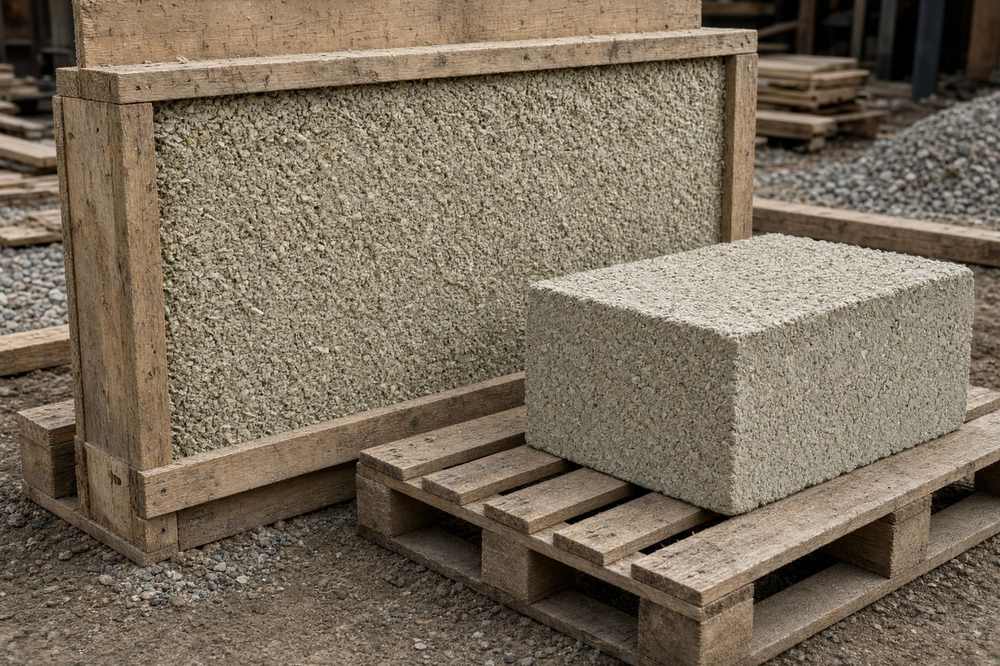
Hempcrete is lime plus hurd. It is a non-structural infill, not a load-bearing block that replaces concrete columns. IRC Appendix BL is the code path. The R-value used with that appendix is about 1.2 to 2.1 per inch, higher at the lighter density.
As of this writing in 2026 the appendix is adopted in Austin, Texas, Maricopa County, Arizona, and Surprise, Arizona. A hurd sold into a wall is a different cut from stall bedding. Low fines. Stable moisture. Same mill, different screen.
Grain is the seed line. NASS 2025 grain utilized value is $8,092,000. Hearts, oil, and press cake come from that seed. They are real products and they are not the stall. A mill built for bedding does not become an oil press because the catalog has a grain card.
The order of markets on this site is deliberate. The stall pays for the acre first, because the bag has a published price and the barns already buy bedding. Bast and hempcrete are the next buyers of fractions the stall does not take. Grain is a separate field.
Floral is a separate law.
Grain’s $8,092,000 is the whole domestic utilized line, not a mill’s revenue target. Canada still ships the larger seed-product volume into the United States. A bedding mill does not close that gap by owning a press.
Hempcrete uses the dusty, short fraction a stall bag does not want. Selling that fraction into a wall is how the mill stops calling it waste.
Source. NASS hempan26.pdf, Apr 2026. Hemp Traders 2026 F-B1. IRC Appendix BL. Dakota bag ladder is a different product.
The modern legal line starts with the 2014 Farm Bill pilot programs, run through universities and state departments of agriculture.
The 2018 Farm Bill took hemp out of the federal controlled-substance definition when it met the 0.3 percent delta-9 THC test and was grown under a state, tribal, or USDA plan. That is the license a fiber farmer still holds.
Public Law 119-37, 12 November 2025, tightens the definition to total THC at or below 0.3 percent dry weight. It defines industrial hemp around the stalk, the grain, and the fiber. Most intoxicating hemp-derived cannabinoid products fall outside.
The change is effective 12 November 2026. USDA has delayed the requirement that compliance labs be DEA-registered until 31 December 2026, because there are not enough registered labs. A lot still needs a pre-harvest test, a certificate of analysis, and a USDA lot tag.
The racetrack is a second gate, and it is stricter. The Horseracing Integrity and Safety Authority (HISA) treats cannabinoids as a banned substance with a near-zero tolerance. A positive test is an administration case until someone proves it is not.
Environmental exposure, dust in a stall, a handler’s hands, is not the same fact as giving a horse a dose. It is also not a waiver. Cornell work associated with Dr. Joseph Wakshlag on cannabinoid pharmacokinetics is the exposure science.
It describes what the horse’s body does with a compound. It is not a therapy claim, and it is not permission to bed a tested horse on a flower product.
Nothing at a HISA track scales before that gate is understood. A private barn can move first. A harness track that has already banned sawdust, as Saratoga Casino Hotel did in writing, can move next.
A Thoroughbred meet under HISA moves when the bedding is plainly the stalk, the lot is clean, and the exposure question has been answered with a test, not with a slogan.
This site does not sell a cannabinoid. The bedding is hurd. The fiber is bast. The grain is seed. If a product needs a flower to make its claim, it does not belong in this classroom or in a stall under this theory.
A clean lot tag is the document that lets a racing office say the bedding is stalk. Without it, the exposure argument is a story.
Source. 2014 Farm Bill pilots. 2018 Farm Bill. P.L. 119-37, 12 Nov 2025, effective 12 Nov 2026. USDA DEA-lab delay to 31 Dec 2026. HISA. Cornell exposure literature, not a therapy claim.
Barn $1,081. Mill hurd and bast. The truck and the pad are a later option.
There are three cash registers. They stay separate.
The first is the barn. One conservative 12 by 12 nets $1,081 a year against pine, after material, labor, haul, and half the compost. Saratoga’s 1,820 published stalls times that net is $1,967,420. That is a count of stalls a racing office has published.
It is not a made-up national market, and it is not the mill’s profit.
The second is the mill. It sells hurd and it sells bast. Hurd for the stall uses the Dakota bag ladder, $20 down to $16 per 30 pounds. Bast uses a labeled band: $0.20 a pound at the NASS retted-stalk floor, $0.40 a pound at the Hemp Traders 2026 truckload ceiling.
Those are different products. Averaging them produces a number nobody pays.
Owning the truck and the pad is a later option. Phase 1 subcontracts haul. The mill opens without it. The barn’s compost credit is already inside the $1,081. A later yard sale of the other share would be a different check, and only after the pile is real.
NASS $0.20 a pound is what the farm was paid for retted stalk in the 2025 fiber line, $13,453,000 on 21,693 acres. Dakota $16 per 30 pounds is what a barn pays for a bag of bedding.
The whole theory is that the stall re-prices the inner stalk from the farm-gate fiber price up to the bag. If a page on this site uses one of those prices for the other product, it is wrong.
When a heading says published stall counts, it means Saratoga 1,820 and Churchill’s own 1,400-plus, and the other counts marked published on the map. An estimate is labeled an estimate. A fantasy national total is not used.
If you need a price for your own stalls, open the ledger. If you need the machine, open the plant page. If you need the truck, open CleanLoop.
Write the three numbers on one line before you add anything: $1,081 at the barn, the bag or the bast pound at the mill, $25 a cubic yard at the pad. If a fourth number appears, ask which register it belongs to. If it belongs to two, delete one.
Source. Stall ledger. NASS hempan26.pdf, Apr 2026. Dakota bag ladder. CleanLoop and compost pages. Saratoga 1,820 published stalls.