Definition
The Horse Stall Theory
Adam Thompson
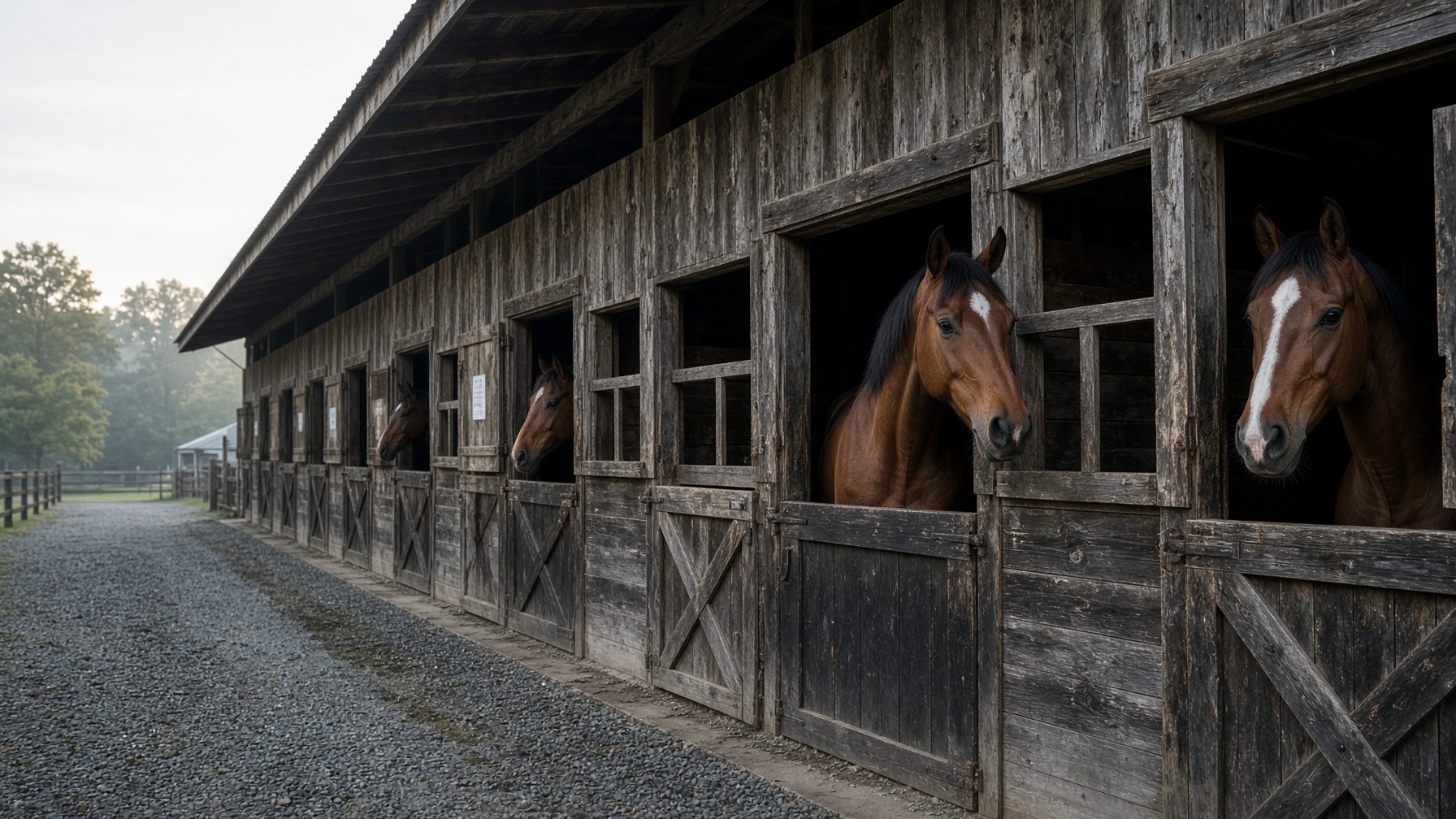
A stalled horse is a contracted pound of hemp hurd, the woody core of the hemp stalk. Processing plants should sit where fiber farmland, horse density, and racetrack backsides meet. That offtake re-prices the inner stalk, about 70 percent of the plant, from the NASS utilized fiber price up to bagged bedding.
1. The inversion
In 2025 the United States harvested 21,693 acres of fiber hemp. NASS utilized value was $13,453,000. That is $0.20/lb and $620/acre (USDA NASS National Hemp Report, April 2026). Floral hemp, on fewer acres, cleared $574,481,000 utilized. Growers learned the wrong lesson: fiber does not pay. Fiber does not pay as a commodity stalk. The inner hurd, 70% of that stalk, is a premium absorbent.
Dakota Hemp is a running mill in Wakonda, South Dakota on a Greenfield decortication train. It publishes a domestic bag schedule: 30 lb at $20, $19 (5+), $18 (10+), $17 (pallet of 40), $16 (multi-pallet), and hurd at $0.60/lb. Pallet-gate is $0.57/lb. That is nearly 3× the NASS utilized fiber price of $0.20/lb retted stalk, on the fraction of the plant that fiber markets treat as leftover. NASS fiber $/lb and Dakota bagged hurd are different products.
2. The stall as a unit of demand
AHC 2023: 6.65 million horses, $122–177 billion economic impact, 12.5 million equine acres. Not all horses stall. This model uses 45% — 2,992,500 animals — as a conservative stalled population. A 12×12 (144 sq ft) takes 1.0–1.5 lb/sq ft to open (Bulk Hemp Warehouse: 145–215 lb; typically six 30 lb bags). Ongoing top-up, conservative, 2.1 lb/sq ft/year (~302 lb). Hemp absorbs 4–5× its weight. Dakota’s own annual analysis: bedding budget cut by almost half, because you stop stripping the stall to the floor every month.
One stall, conservative, 12×12 vs pine, Dakota multi-pallet bag price
$1,081
Material + labor + haul + half the compost value
Hurd in / year
302.4 lb
11 bags at $16.00
Waste out / year
6 cy
vs 10 cy pine. Compost 6–9 mo.
3. National offtake, not a fantasy TAM
2,992,500 stalled × 302 lb = 905 million lb of hurd. At 2,173 lb hurd/acre (70% of USDA’s 3,104 lb fiber yield) that is 416,444 acres — versus 21,693 fiber acres harvested in 2025. A 27× scale-up, only if conversion is complete, which it will not be. A 10% conversion is still 41,644 acres and $51,279,480 of pallet-gate hurd. The global horse-stall bedding market is projected at $981,400,000 by 2031; North America was $54,780,000 in 2023. Those figures are the current bedding category, mostly pine and straw. Hemp is a substitution play inside them, and a fiber-mill play beside them.
4. Why the mill sits next to the barn
Hurd is bulky. Every extra hundred miles eats the spread between $0.20/lb NASS utilized fiber and $0.57 Dakota pallet bag. Racetracks concentrate stalls: Saratoga 1,820 published stalls (90 barns) is a single-meet offtake letter. Churchill houses 1,400+ horses a year on the backside. Training capitals (Ocala, Lexington, Weatherford) stall horses that never appear in a racing program. The map scores states on herd + 2025 hemp acres + backside stalls.
Machinery reality (GM Insights): decorticator ~$229,000, hemp combine ~$550,000. IMARC: processing plants in the 5–10k MT class run 40–50% gross, 15–25% net when they actually have a bid. The stall is that bid.
5. The 2026 legal lane
P.L. 119-37 (12 Nov 2025) redefines hemp as total THC <0.3% dry weight, explicitly includes industrial hemp, excludes most intoxicating hemp-derived cannabinoid products (>0.4 mg THC/container). Effective 12 Nov 2026. DEA-lab testing enforcement delayed to 31 Dec 2026.
Floral was 77.7% of 2025 hemp value. That lane is being narrowed on purpose. Industrial hemp — fiber, hurd, grain, seed, hempcrete, paper, composites — is the explicit remainder. Fiber held 49.6% of harvested acres and 1.8% of value. A mill that beds horses and walls houses does not need a cannabinoid story.
6. What the ledger will not do
- It will not treat estimated track stalls as counted. Saratoga and Churchill are labeled. The rest say estimated.
- It defaults to conservative labor (25% cut, not 40%) and books only half the compost revenue.
- It will not price below the Dakota multi-pallet floor to win a barn. Starving the grower kills the mill.
- State horse counts are AHC-style density, scaled under 6.65 million, not a USDA farm census.